


Introduction
Few figures in architectural history have left as enduring a mark as Le Corbusier, and nowhere is his influence more evident than in the extraordinary Le Corbusier buildings that reshaped how the world thinks about urban living, spatial design, and modernist principles. Whether you’re an architecture student, design enthusiast, or urban planner, exploring his structures offers a window into the foundations of contemporary architecture.
In this article, we’ll dive deep into his most iconic projects—from the sculptural curves of Villa Savoye to the monumental power of the Chandigarh Capitol Complex. You’ll learn about the design philosophies that defined his work, the global locations of his 17 UNESCO-listed sites, and what makes these buildings essential pilgrimage sites for architecture lovers today.
By the end, you’ll have a clear understanding of his architectural legacy, why his buildings still set standards for functionality and aesthetics, and which sites you should add to your travel bucket list.
Table of Contents
Who Was Le Corbusier and Why Do His Buildings Matter?
Le Corbusier (1887–1965), born Charles-Édouard Jeanneret, was a Swiss-French architect, urban planner, writer, and designer. As one of the founders of modern architecture, he promoted ideas such as:
- The Five Points of Architecture
- Open floor plans
- Pilotis (supporting columns)
- Free façades
- Roof gardens
- Horizontal ribbon windows
His vision was not only aesthetic—it was social. He believed architecture should improve living conditions for all, a philosophy embodied in many of his residential projects.
A 2023 report from the International Council on Monuments and Sites states that Le Corbusier’s work “remains foundational for understanding 20th-century architectural innovation,” showing how relevant his contributions continue to be.
The Five Points of Architecture: A Blueprint for His Buildings
Le Corbusier introduced the Five Points in 1926, principles that would shape most of his iconic buildings.
Five Points Explained
- Pilotis
Reinforced concrete columns lift the building, freeing ground space and improving circulation. - Roof Gardens
Flat rooftops reclaim green space lost to the building footprint. - Open Floor Plan
Non-load-bearing walls allow flexible, adaptable interior layouts. - Horizontal Ribbon Windows
Long, continuous windows provide balanced natural light. - Free Façade
Structural support removed from the exterior enables creative façade design.
Why it matters: These principles influenced designs for decades and continue to guide sustainable architecture today.
Top 10 Most Iconic Le Corbusier Buildings
1. Villa Savoye — Poissy, France
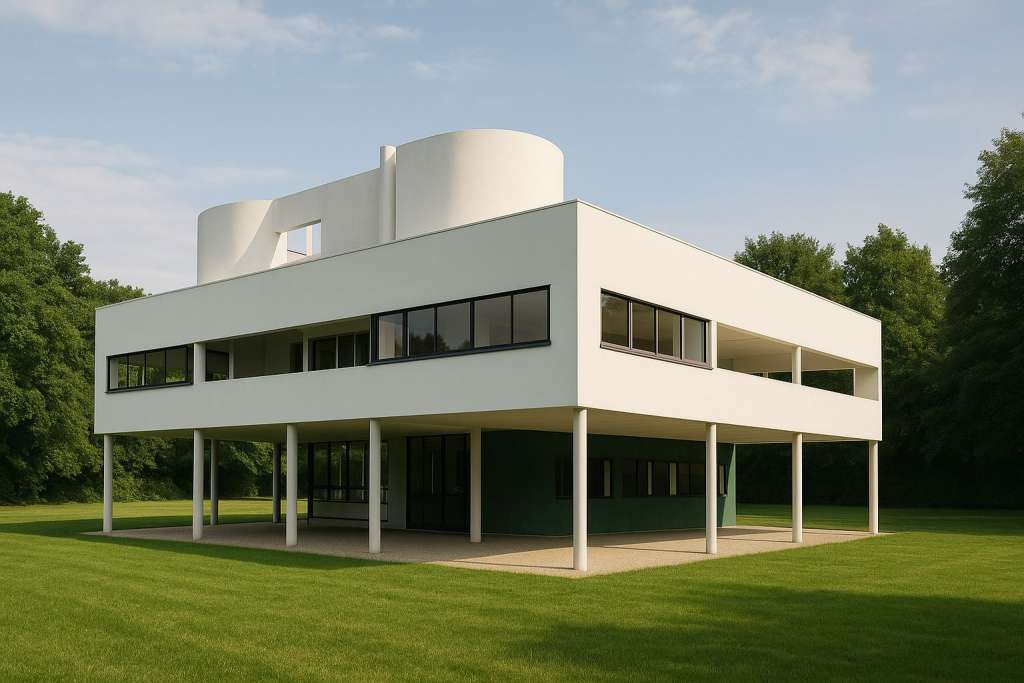
Arguably the purest expression of the Five Points, Villa Savoye (1929–1931) is frequently called “the machine for living.”
Why it’s iconic:
- Ribbon windows stretch across the façade
- A flowing interior promenade
- A rooftop terrace with panoramic views
Architecture critic Reyner Banham once described it as “a manifesto built in concrete.”
2. Unité d’Habitation — Marseille, France
The first and most famous of Corbusier’s housing units, the Unité d’Habitation (1947–1952), reimagined urban living.
Key features:
- Modular apartments based on the “Modulor” scale
- Communal facilities (shops, gym, kindergarten)
- Sculptural rooftop resembling a small village
This building later inspired brutalist structures worldwide.
3. Notre-Dame du Haut — Ronchamp, France
The chapel at Ronchamp (1955) breaks from Corbusier’s earlier rationalist style with its dramatic curves and thick masonry walls.
What stands out:
- Light filters through colorful stained-glass apertures
- The roof appears to float above the walls
- Organic forms inspired by nature and spirituality
4. Chandigarh Capitol Complex — India
One of his largest urban projects, the governmental district of Chandigarh features monumental concrete forms including:
- The Palace of Assembly
- The Secretariat
- The High Court
- The symbolic Open Hand Monument
Designated a UNESCO World Heritage Site in 2016, it remains a functioning administrative hub.
5. La Tourette Monastery — Éveux, France
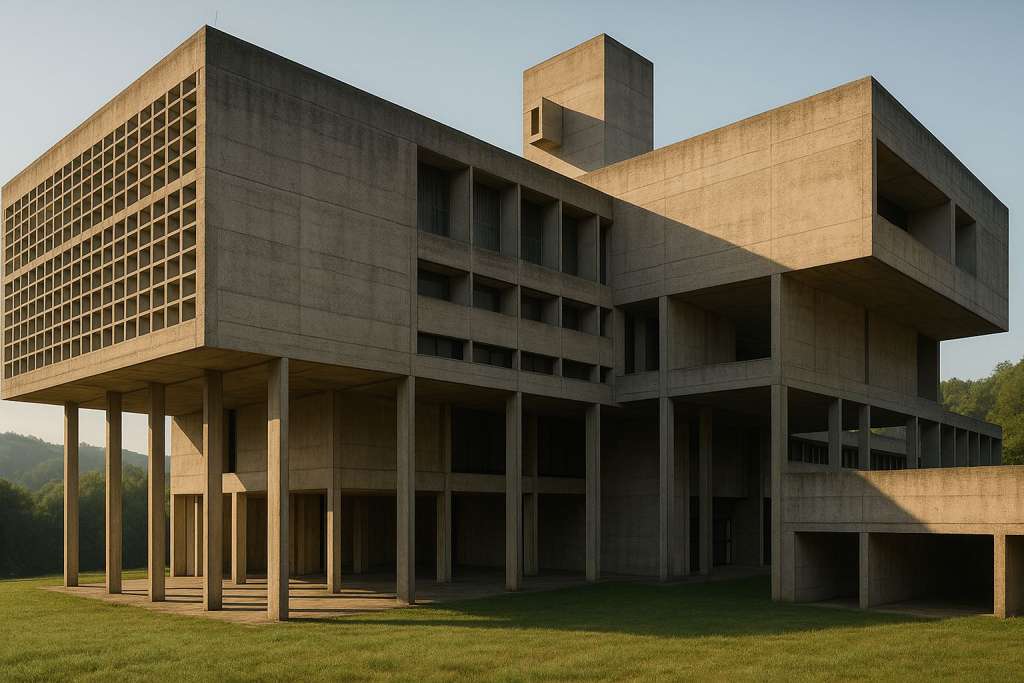
The Sainte Marie de La Tourette monastery (1960) blends monastic austerity with modernist logic.
Highlights:
- Brutalist concrete aesthetic
- Modular cells for monks
- Masterful use of light in the chapel
Other Noteworthy Works
- Maison La Roche — Paris, France
A gallery-home blending curves and clean geometry - Carpenter Center for the Visual Arts — Cambridge, Massachusetts
His only building in the United States - National Museum of Western Art — Tokyo, Japan
Based on Corbusier’s “museum of unlimited growth” - Maisons Jaoul — Neuilly-sur-Seine, France
A shift to more textured, brick-and-concrete designs - Maison Guiette — Antwerp, Belgium
An early work showing his transition to modernism
What Makes Le Corbusier Buildings Unique?
1. Human-Scaled Design (The Modulor System)
Corbusier created the Modulor, a system based on human body proportions. This ensured that:
- Spaces feel intuitive
- Furniture and circulation paths fit naturally
- Light and volume create comfort
2. Sculptural Use of Concrete
He transformed raw concrete into expressive, dynamic forms—paving the way for Brutalism.
3. Integration of Art and Architecture
Many buildings incorporate murals, sculptures, and bold color palettes.
4. Social Vision for Better Living
His collective housing concepts influenced city planning worldwide.
5. UNESCO World Heritage Sites: Where to Find Them
In 2016, 17 Le Corbusier buildings across seven countries were added to the UNESCO list. These include:
- Villa Savoye (France)
- Unité d’Habitation (France)
- La Tourette Monastery (France)
- Chandigarh Capitol Complex (India)
- National Museum of Western Art (Japan)
- Maison Guiette (Belgium)
- Maisons Jaoul (France)
Why UNESCO listed them:
They represent “the invention of a new architectural language that transformed global design standards.”
6. Visiting Le Corbusier Buildings: Tips for Architecture Travelers
Best time to visit:
- Spring and autumn offer ideal lighting and weather.
- Weekdays usually have fewer crowds.
What to look for onsite:
- Interplay of light and shadow
- Circulation paths (ramps vs. stairs)
- Material texture contrasts
- Transitional spaces between public and private zones
Travel tips:
- Many buildings offer guided tours for deeper insight.
- Photography restrictions vary—verify beforehand.
7. How Le Corbusier Influences Architecture Today
Le Corbusier’s legacy shapes:
- Sustainable design — rooftop gardens anticipated today’s green roofs
- Urban planning — zoning and communal amenities
- Minimalist interiors — clean geometry, open layouts
- Concrete design — foundations for Brutalism and contemporary sculptural forms
A 2022 RIBA survey revealed that over 70% of architecture students study Corbusier’s work as a foundational reference.
Conclusion
Le Corbusier’s buildings continue to inspire architects, designers, and travelers with their bold forms, human-centered approach, and visionary ideas. Whether you’re exploring the floating roof of Ronchamp or the bustling community of Unité d’Habitation, each structure offers a unique glimpse into the evolution of modern architecture.
Interested in discovering more architectural icons?
👉 Subscribe to the blog, share your favorite Le Corbusier building in the comments, or explore our related guides on Modernism and Brutalism. Visit us- https://architectplusinterior.com/
